
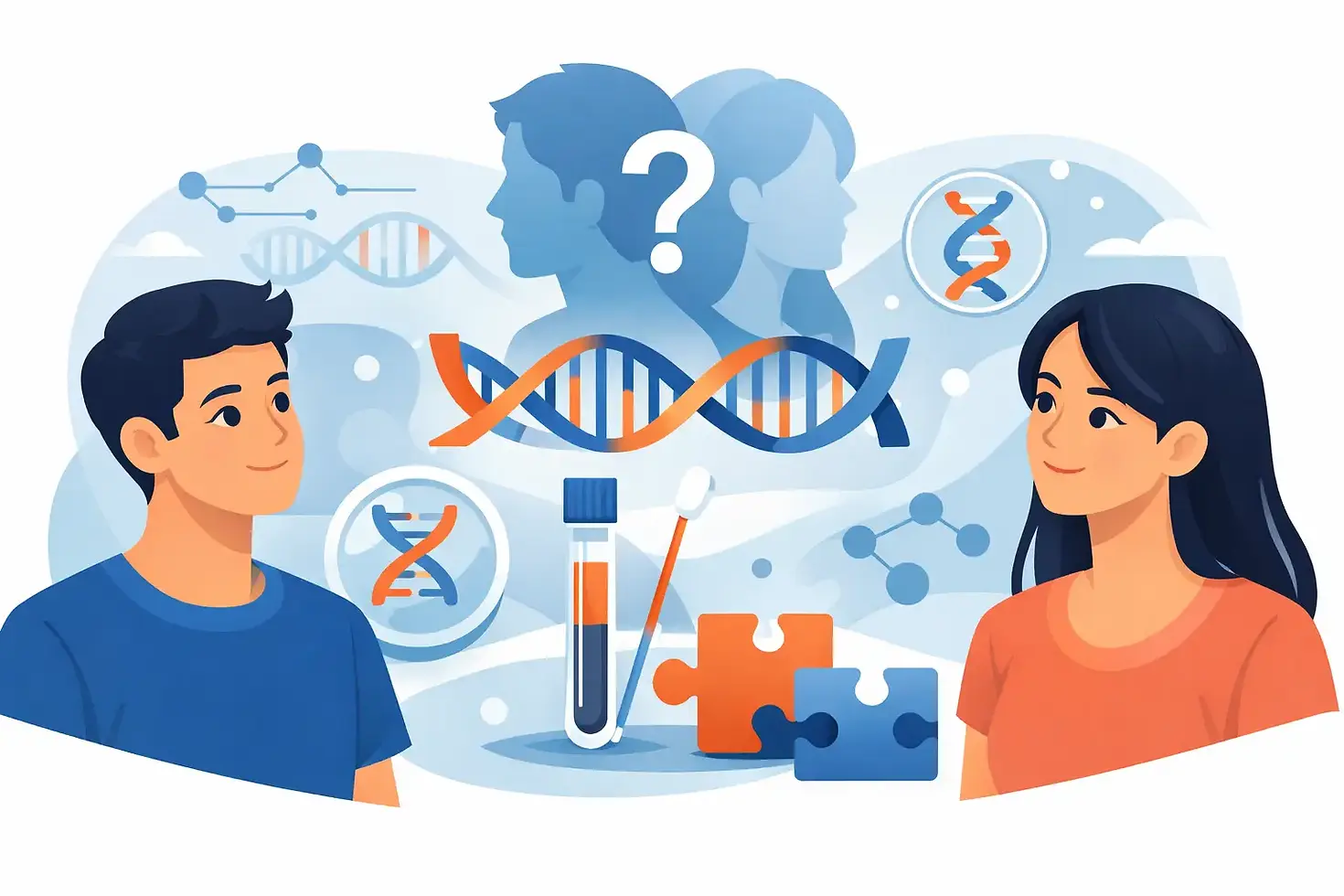
DNA Test for Siblings: What It Can Prove
A dna test for siblings usually comes up when a family needs a clear answer fast - not a long lesson in genetics. Maybe two people want to confirm whether they share one or both parents. Maybe paperwork, inheritance questions, immigration needs, or personal peace of mind are pushing the issue. Whatever the reason, the real question is simple: what can this test actually tell you, and how reliable is it?
What a DNA test for siblings can show
A sibling DNA test looks at how much genetic material two people share. The goal is to estimate whether they are full siblings, half siblings, or not biologically related in the way they believe.
That sounds straightforward, but there is some nuance. A sibling test does not usually identify a shared parent directly unless that parent is also tested. Instead, it compares the DNA profiles of the two individuals and calculates how likely their relationship is. The result is typically reported as a likelihood ratio or probability supporting one relationship over another.
If both alleged siblings share the same biological mother and father, the testing may support a full sibling relationship. If they share only one biological parent, the result may support a half sibling relationship. In some cases, the results may show that the claimed relationship is unlikely.
Why people choose sibling testing instead of paternity testing
The most accurate family relationship testing usually includes the known parent. If the father is available, a paternity test is often the clearest route. If the mother is available, adding her DNA can also strengthen the analysis.
But families are not always working with ideal circumstances. Sometimes the alleged father is unavailable, unwilling to test, deceased, or simply unknown. In those cases, a dna test for siblings can be a practical alternative.
This is common in situations involving estate issues, family reunification, birth record questions, or personal confirmation between adults. It is also common when people want private answers without dealing with insurance, referrals, or extra appointments.
How the test works
Most sibling DNA tests use a cheek swab sample. The collection process is simple, noninvasive, and fast. A lab analyzes genetic markers from each person and compares the results to see how strongly they support a sibling relationship.
The science behind it is solid, but interpretation matters. Siblings can share a lot of DNA, but the amount varies. Full siblings generally share more DNA than half siblings, and half siblings generally share more than unrelated individuals. Still, genetics has natural overlap. That is why a lab does not just say yes or no based on one marker. It uses multiple markers and statistical analysis to reach a conclusion.
In some cases, the lab may recommend testing additional family members. Including a mother, known sibling, or other close biological relative can make the result more informative.
Full siblings vs half siblings
This is one of the biggest reasons people seek a DNA test for siblings. They may already believe there is a biological connection but want to know whether they share both parents or only one.
That question can often be addressed, but not always with perfect certainty if only two siblings are tested. Full sibling and half sibling results are based on probabilities, and some cases fall into a gray area. If the shared DNA pattern is close to the borderline, a lab may not be able to make as strong a distinction as a customer hoped.
That does not mean the test failed. It means the result should be read honestly. Good labs explain whether the data strongly supports one relationship, weakly supports it, or remains inconclusive without more testing.
When results are most reliable
Sibling testing is most reliable when sample collection is handled correctly and the lab uses a strong set of genetic markers. Reliability also improves when there is more context.
For example, if two people believe they share the same father but have different mothers, that background helps shape the analysis. If one known parent participates, the interpretation gets stronger. If more relatives are included, the lab has more information to work with.
The biggest trade-off is this: sibling testing can provide strong evidence, but it may not be as definitive as direct parent-child testing. For many people, that level of certainty is still enough. For legal or court-related needs, though, it is smart to confirm whether the specific test format meets the requirement.
At-home vs collected testing
Some people assume all DNA testing works the same way. It does not. There is a difference between informational testing and testing that may be used for legal purposes.
An informational sibling test is usually for personal knowledge. It answers a family question but may not be accepted by courts, immigration agencies, or other institutions.
A legal test follows a documented chain of custody. That means identities are verified, samples are collected under controlled procedures, and the handling process is recorded from start to finish. If you need results for an official matter, this step matters.
If your goal is peace of mind only, a standard private test may be enough. If your goal is documentation, ask about legal sibling testing before booking.
What to expect from the process
For most adults, the process is simple. You choose the test, schedule the collection, provide your samples, and wait for the lab to complete the analysis. Results are usually delivered confidentially.
The easier part is the sample. The harder part is often emotional. Family DNA testing can confirm a long-held belief, raise new questions, or reopen old ones. That is worth considering before you begin. People often focus on cost and timing, but not enough on what they will do with the answer.
Still, there is value in having clear information. Uncertainty can drag on for years. A direct lab process gives people a way to get answers without unnecessary red tape.
Cost, speed, and convenience matter
For many customers, this is not just about science. It is also about access. Traditional healthcare channels can make even simple testing feel harder than it needs to be. Appointments, referrals, insurance questions, and delayed scheduling add friction.
A direct-pay lab model is appealing because it keeps the process simple. No Insurance, No Doctor Referral Needed. That matters for privacy-conscious customers, uninsured adults, and anyone who wants to handle a personal family question quickly and confidentially.
If you are in Hallandale Beach or nearby areas such as Aventura, Hollywood, Sunny Isles Beach, Dania Beach, or North Miami Beach, using a local testing provider can make the process even easier. You can book directly, get the sample collected professionally, and receive your results through a secure portal instead of navigating multiple offices.
Common reasons people get inconclusive results
Most people want a firm answer, but biology does not always cooperate. A result can be inconclusive if the shared DNA pattern is not strong enough to clearly separate one relationship from another. This is more likely when only two people are tested and no parent is available for comparison.
Poor sample quality can also create problems, though that is less common when collection is done properly. In other situations, the issue is not the lab work at all - it is the family history. If the assumed relationship is different from the actual biological relationship, the result may not fit the original question cleanly.
This is why expectations matter. A sibling test can be very useful, but it is not magic. It provides evidence, and sometimes strong evidence, yet some cases require added relatives or a different test strategy.
Before you book a DNA test for siblings
Start with the end goal. If you only want private answers, that is one path. If you need documentation for legal purposes, choose the right collection method from the start.
It also helps to ask whether any other relative can participate. Adding a known mother or another sibling may increase clarity. And if your situation is sensitive, choose a provider that keeps the process confidential, straightforward, and easy to schedule.
A good testing experience should not feel complicated. You should know what the test can answer, what it cannot promise, what it costs, and how results will be delivered. That level of clarity matters just as much as the lab analysis.
Family questions can sit unresolved for a long time because people assume the process will be expensive, awkward, or hard to arrange. Often, it is simpler than expected. The most helpful next step is usually not overthinking the science - it is getting the right test for the answer you actually need.


Comments